What Is an AI Agent and How to Build One: A Visual and Practical Guide
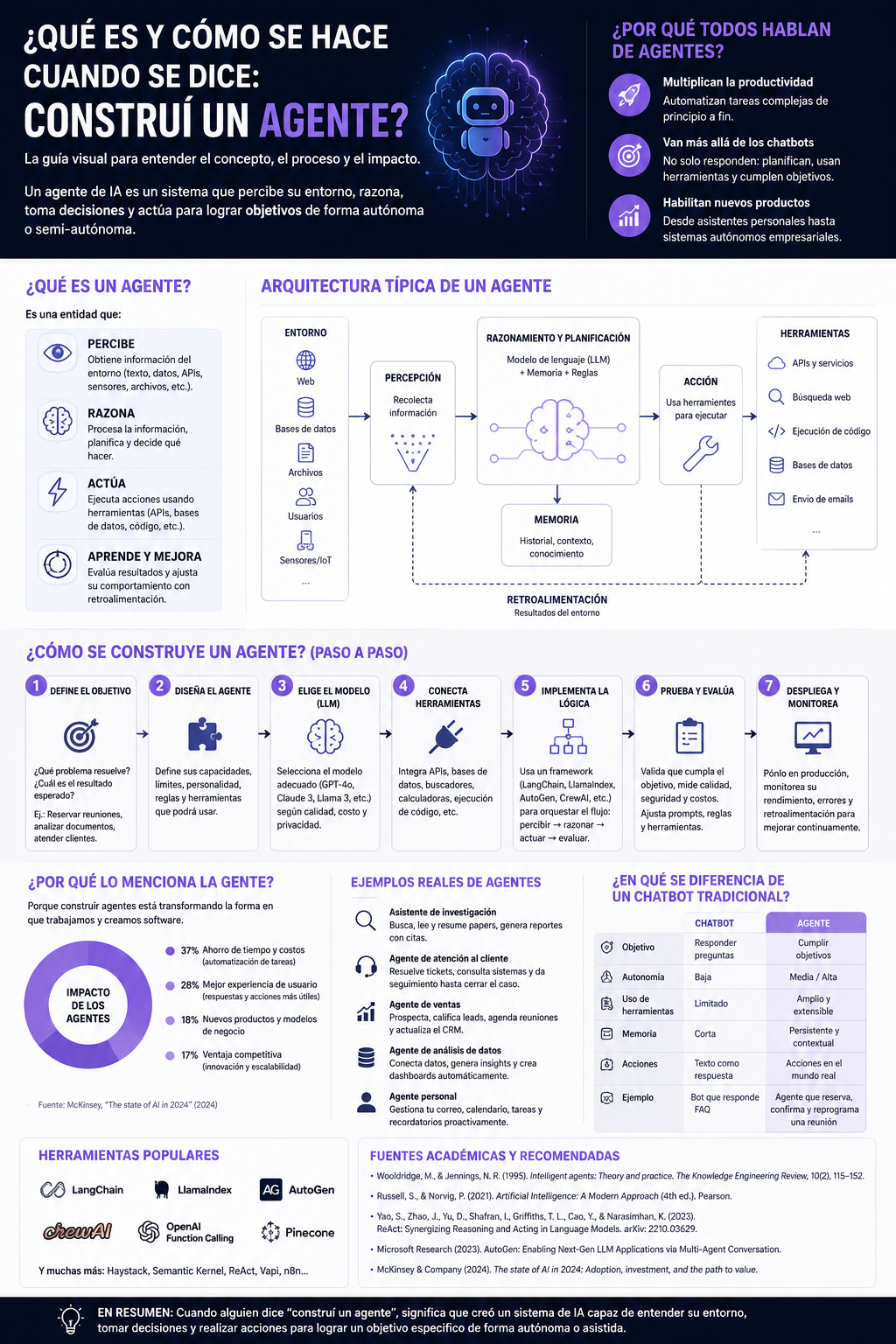
An infographic in Spanish that explains what an AI agent is, its architecture, the steps to build one, why it's important, examples of its use, differences from a traditional chatbot, common tools, and references.
- Complexity
- Introductory
- Reading
- 5 min read
- Published
While the image is fitted, the left and right arrows move to the previous and next infographic. Once it is zoomed in, the arrows move the image instead. The plus and minus keys zoom, and the zero key fits it again.
Loading the image…
About this infographic
Editorial summary of the content shown in the infographic: - Defines an AI agent as a system that perceives its environment, reasons, acts, and learns to achieve objectives autonomously or with assistance. - Reasons for interest: increases productivity, goes beyond chatbots, and enables new products. - Typical architecture: environment (data sources and sensors), perception (data collection), reasoning and planning using LLM + memory + rules, action via tools (APIs, web search, code execution, databases, email), memory (history and context), and feedback from the environment. - Steps to build it: 1) define the objective, 2) design capabilities and rules, 3) choose the LLM, 4) connect tools, 5) implement the logic using frameworks, 6) test and evaluate, 7) deploy and monitor. - Reported impact (source cited: McKinsey, 2024): time and cost savings, improved user experience, new products and models, competitive advantage. - Examples: research assistant, customer service agent, sales prospecting, personal assistant, data agent. - Comparison with chatbots: agents aim to achieve objectives with greater autonomy, persistent memory, real-world actions, and verifiable results. - Popular tools shown: LangChain, LlamaIndex, AutoGen, CrewAI, OpenAI Function Calling, among others. - Sources listed: academic papers and reports from Microsoft Research and McKinsey. Note: This is an editorial summary; it is not a verbatim transcription of the text in the image.
Key takeaways
- An AI agent perceives, reasons, acts, and learns in order to achieve its goals.
- The architecture integrates LLM, memory, rules, and tools for executing actions.
- Building it involves defining objectives, designing capabilities, choosing a model, integrating tools, implementing logic, validating, and deploying.
- Agents outperform traditional chatbots because they have autonomy, persistent memory, and the ability to act.
- Applications: research, customer support, sales, personal organization, and data analysis.
- The impact figures cited come from a 2024 McKinsey report shown in the image.
- Common frameworks and functions: LangChain, LlamaIndex, AutoGen, CrewAI, and function calls.