Relational Databases vs. NoSQL: A Practical Guide to Making a Decision
A clear comparison between relational (SQL) and NoSQL models, including their strengths, ideal use cases, NoSQL categories, and guidelines for choosing or combining them in a polyglot architecture.
- Complexity
- Introductory
- Reading
- 5 min read
- Published
While the image is fitted, the left and right arrows move to the previous and next infographic. Once it is zoomed in, the arrows move the image instead. The plus and minus keys zoom, and the zero key fits it again.
Loading the image…
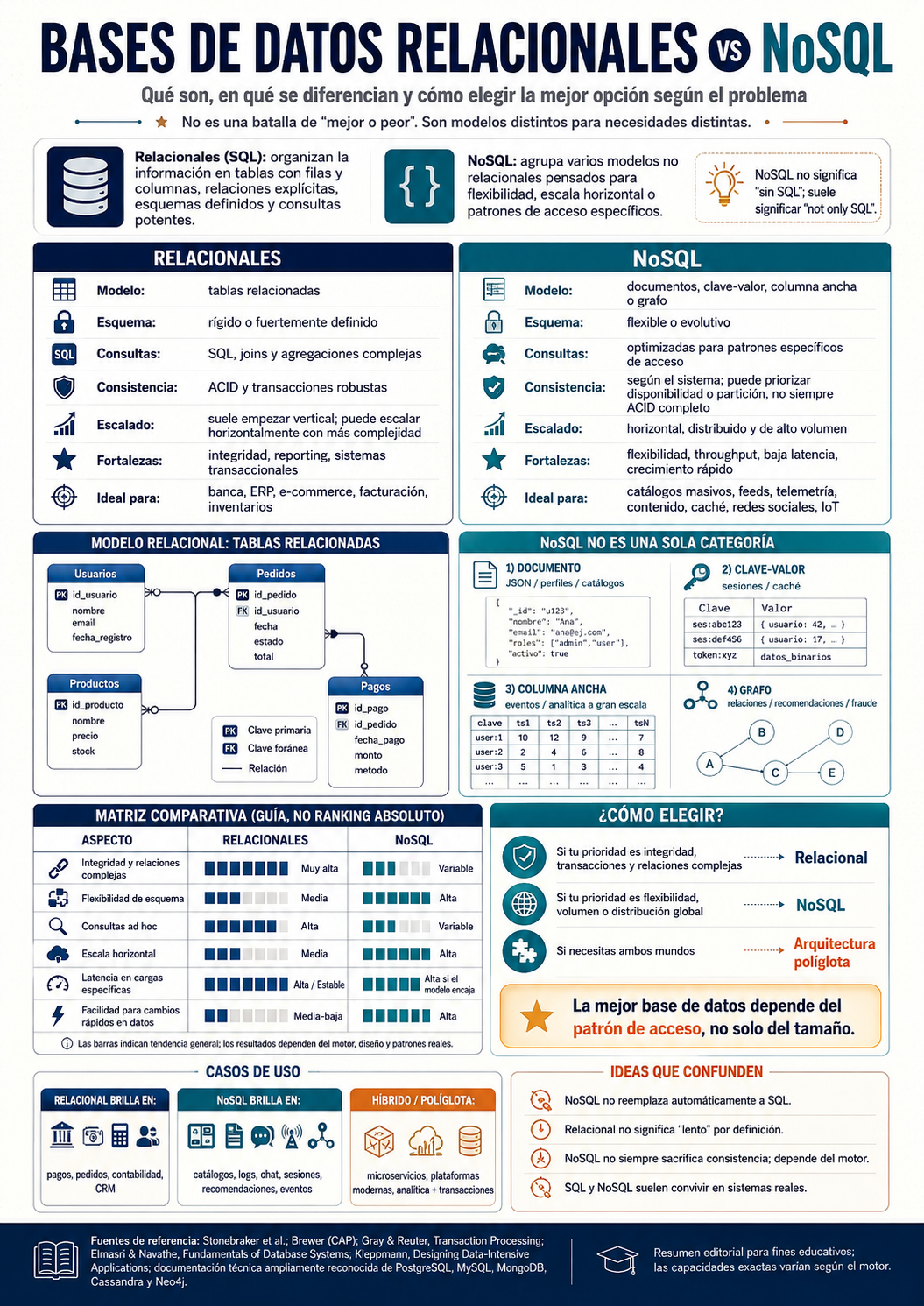
About this infographic
Editorial summary (not a verbatim transcript): - Central idea: There is no universal “best” option; SQL and NoSQL address different needs. “NoSQL” usually stands for “not only SQL.” - Relational (SQL): • Table-based model with rows/columns and explicit relationships. • Defined/rigorous schema; powerful SQL queries, joins, and aggregations. • ACID consistency and robust transactions; typically scales vertically first. • Strengths: integrity, reporting, transactions; ideal for banking, ERP, e-commerce, billing, and inventory. - NoSQL: • Models: document, key-value, wide-column, and graph; flexible or evolving schema. • Queries optimized for access patterns; consistency depends on the engine (may prioritize availability or partitioning). • Horizontal and distributed scaling, high volume; strengths: flexibility, throughput, low latency, and rapid growth. • Ideal for massive catalogs, feeds, telemetry, content, caching, social media, and IoT. - NoSQL is not a single category: • Document (JSON), Key-value (sessions/cache), Wide-column (events/large-scale analytics), Graph (relationships/recommendations/fraud). - Comparative matrix (trends): • Integrity and complex relationships: relational advantage. • Schema flexibility and horizontal scaling: NoSQL advantage. • Complex ad hoc queries: relational advantage. • Latency under massive loads and schema changes: typically favors NoSQL. • Cost per GB: varies depending on the engine and usage pattern. - How to choose: • Priority on integrity and complex transactions → Relational. • Priority on flexibility, volume, or global distribution → NoSQL. • Need both → Polyglot architecture. - Notable use cases: • Relational: payments, orders, accounting, CRM. • NoSQL: catalogs, logs, chat/sessions, recommendations, events. • Hybrid: microservices and modern platforms that combine analytics and transactions. - Debunked myths: NoSQL does not automatically replace SQL; relational does not mean “slow”; NoSQL does not always imply eventual consistency; in practice, they often coexist.
Key takeaways
- It's not a matter of which is better or worse: each model addresses different needs.
- Relational databases prioritize integrity, transactions, and complex SQL queries.
- NoSQL prioritizes schema flexibility, horizontal scaling, and low latency.
- NoSQL includes document, key-value, wide-column, and graph databases; it is not a single technology.
- The decision depends on the system's access pattern and priorities, not just on the amount of data.
- Multilingual architectures combine both approaches in real-world systems.