How LLMs and AI Really Work
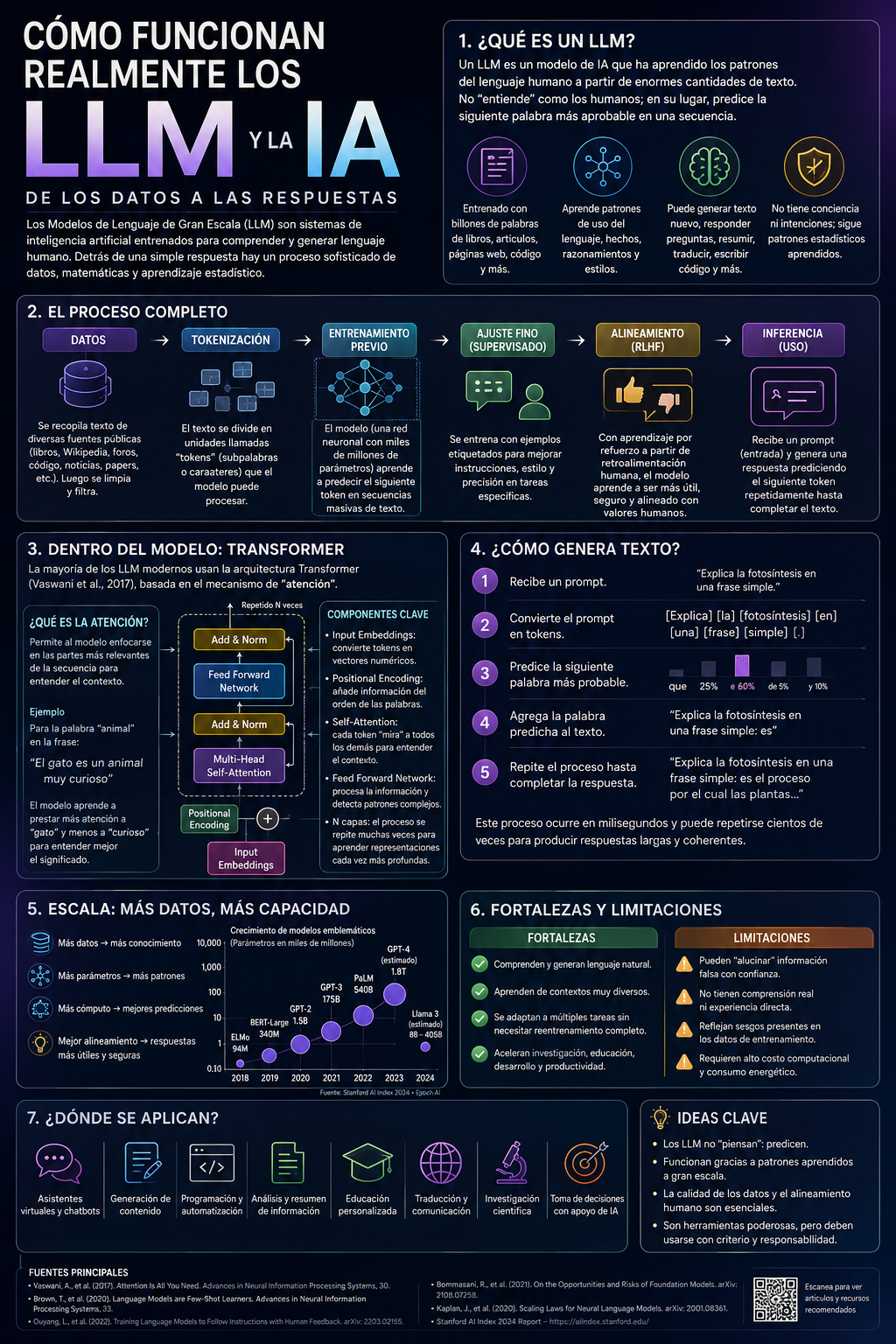
An infographic in Spanish that visually explains what a large language model (LLM) is, its training and usage cycle, the Transformer architecture, how it generates text, the role of scale, its strengths and limitations, and use cases.
- Complexity
- Introductory
- Reading
- 5 min read
- Published
While the image is fitted, the left and right arrows move to the previous and next infographic. Once it is zoomed in, the arrows move the image instead. The plus and minus keys zoom, and the zero key fits it again.
Loading the image…
About this infographic
Editorial Summary: This article explains what an LLM is (a model that learns language patterns and predicts the next token), details the workflow from data collection and cleaning through tokenization, pretraining, supervised fine-tuning, alignment with human feedback (RLHF), and inference. It explains the Transformer architecture and the attention mechanism, including its key components (embeddings, positional encoding, multi-head self-attention, feed-forward networks, and residual connections). It describes the step-by-step process of text generation from a prompt, repeating the prediction and adding tokens to form responses. It includes a panel on “scale” that relates more data, parameters, and better alignment to greater capacity, along with a timeline of representative models. It highlights strengths (natural language understanding and generation, learning from diverse contexts, multitasking, accelerated research, and increased productivity) and limitations (hallucinations, biases, the need for context and supervision, and costs). It concludes with areas of application: virtual assistants, assisted programming, information analysis and summarization, personalized education, translation/communication, scientific research, and decision support, as well as key ideas regarding accountability and data quality.
Key takeaways
- An LLM predicts the next token based on patterns learned from large text corpora.
- The lifecycle includes: data, tokenization, pre-training, fine-tuning, alignment, and use in inference.
- Transformers use attention to capture dependencies and context at different distances.
- Text generation iterates through token-by-token predictions guided by the prompt.
- Scale (more data, parameters, and proper alignment) usually improves capacity and utility.
- LLMs can be useful for a variety of tasks, but they can hallucinate, reflect biases, and require supervision.
- Data quality and prompt design have a significant impact on the responses.
- They are powerful tools that require responsible use and human verification.