Key AWS Services (Visual Guide 2026)
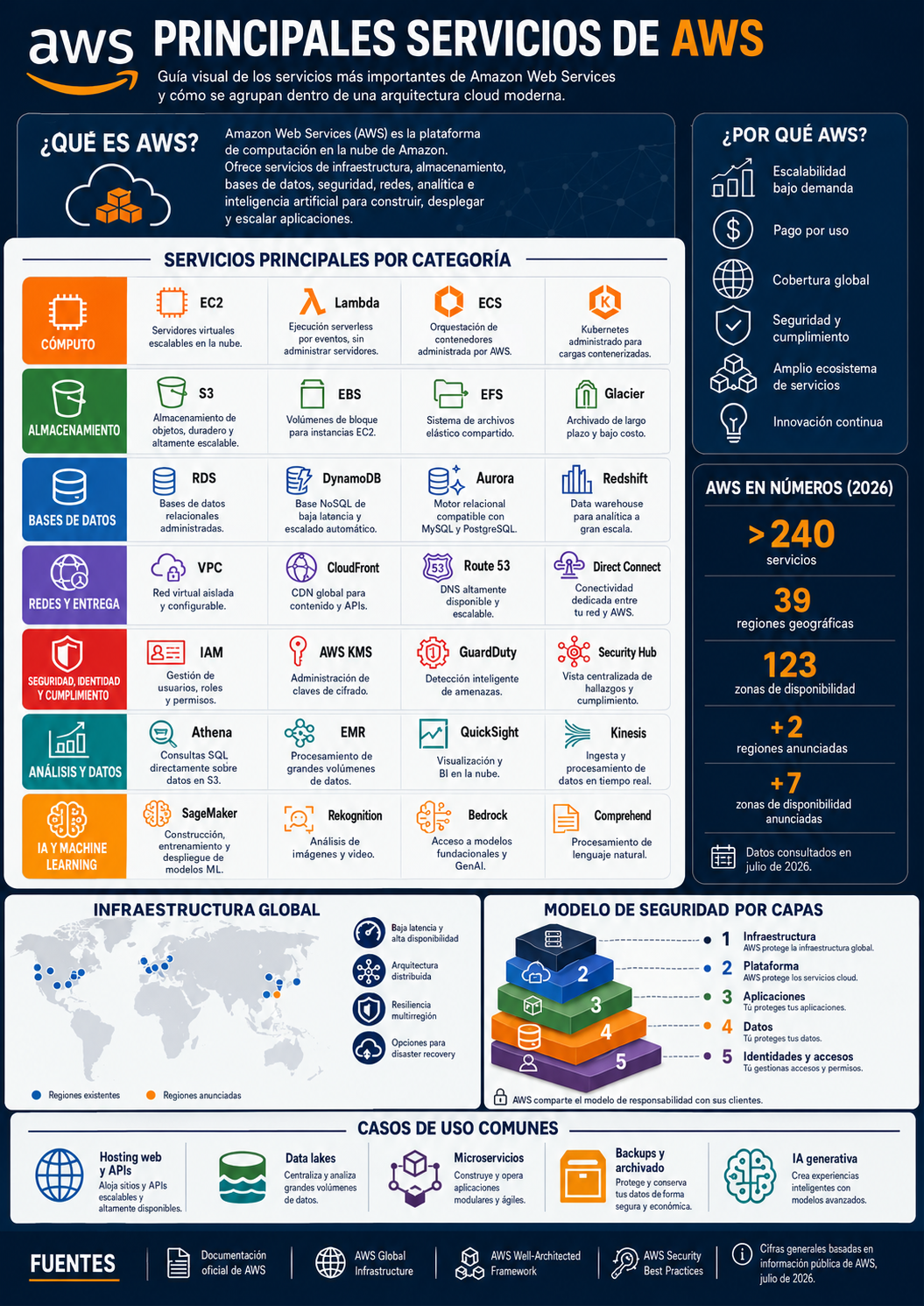
An illustrated summary in Spanish of key AWS categories and services, global figures for 2026, the layered security model, infrastructure, and common use cases.
- Complexity
- Introductory
- Reading
- 5 min read
- Published
While the image is fitted, the left and right arrows move to the previous and next infographic. Once it is zoomed in, the arrows move the image instead. The plus and minus keys zoom, and the zero key fits it again.
Loading the image…
About this infographic
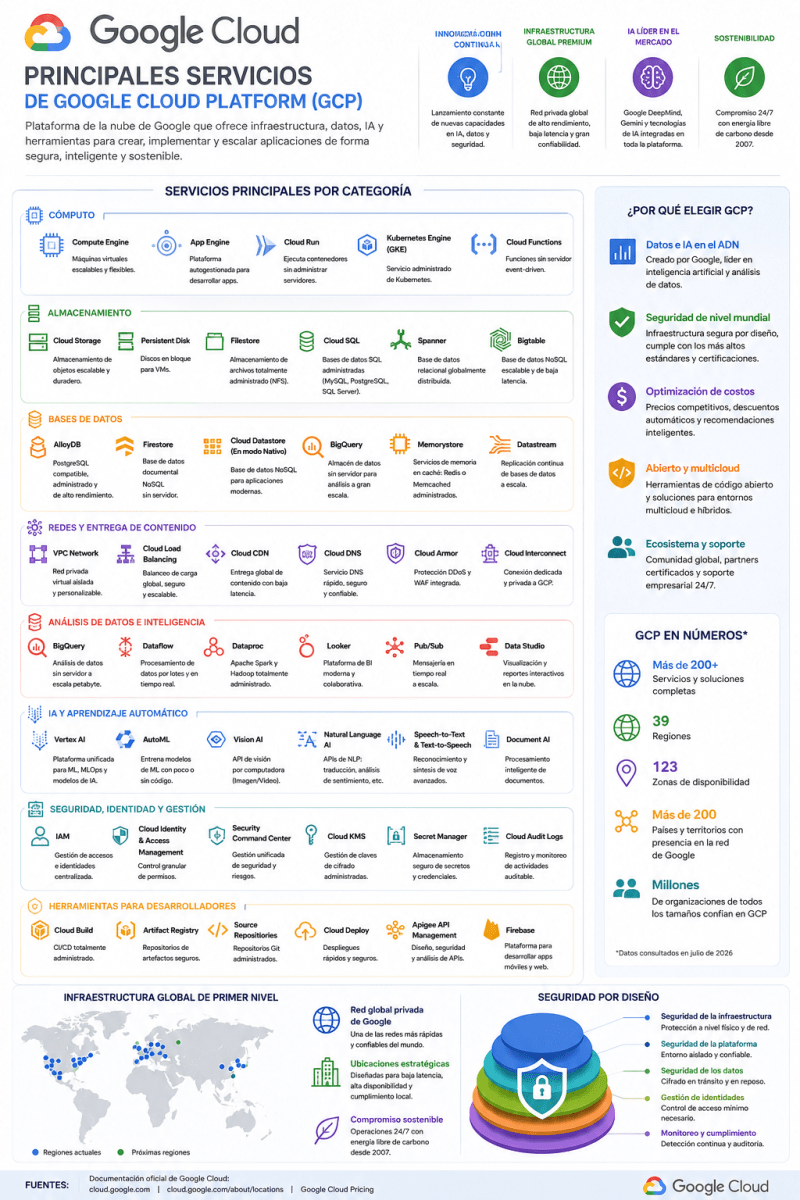
What is AWS: Amazon’s cloud computing platform for deploying and scaling applications. Why AWS: on-demand scalability, pay-as-you-go pricing, global coverage, security and compliance, a broad ecosystem, and continuous innovation. Services by category (examples): - Compute: EC2, Lambda, ECS, EKS. - Storage: S3, EBS, EFS, Glacier. - Databases: RDS, DynamoDB, Aurora, Redshift. - Networking and Delivery: VPC, CloudFront, Route 53, Direct Connect. - Security, Identity, and Compliance: IAM, AWS KMS, GuardDuty, Security Hub. - Analytics and Data: Athena, EMR, QuickSight, Kinesis. - AI and Machine Learning: SageMaker, Rekognition, Bedrock, Comprehend. AWS by the Numbers (2026): >240 services; 39 geographic regions; 123 availability zones; +2 regions announced; +7 availability zones announced. Data as of July 2026. Global infrastructure: map showing existing and announced regions; low latency and high availability; distributed architecture; resilience and disaster recovery. Layered security model: 1) Infrastructure; 2) Platform; 3) Applications; 4) Data; 5) Identities and access. Shared responsibility model. Common use cases: web hosting and APIs; data lakes; microservices; backups and archiving; generative AI.
Key takeaways
- AWS brings together services for infrastructure, data, security, networking, analytics, and AI.
- The guide organizes services into seven main categories, with specific examples.
- As of 2026, there are >240 services, 39 regions, and 123 coverage areas, with expansions announced.
- The security model is organized in layers and based on shared responsibility.
- The global infrastructure is designed for low latency, high availability, and resilience.
- Key use cases: hosting, data lakes, microservices, backups and archiving, and generative AI.