HTTP Explained: Methods, Request Flow, and Key Status Codes
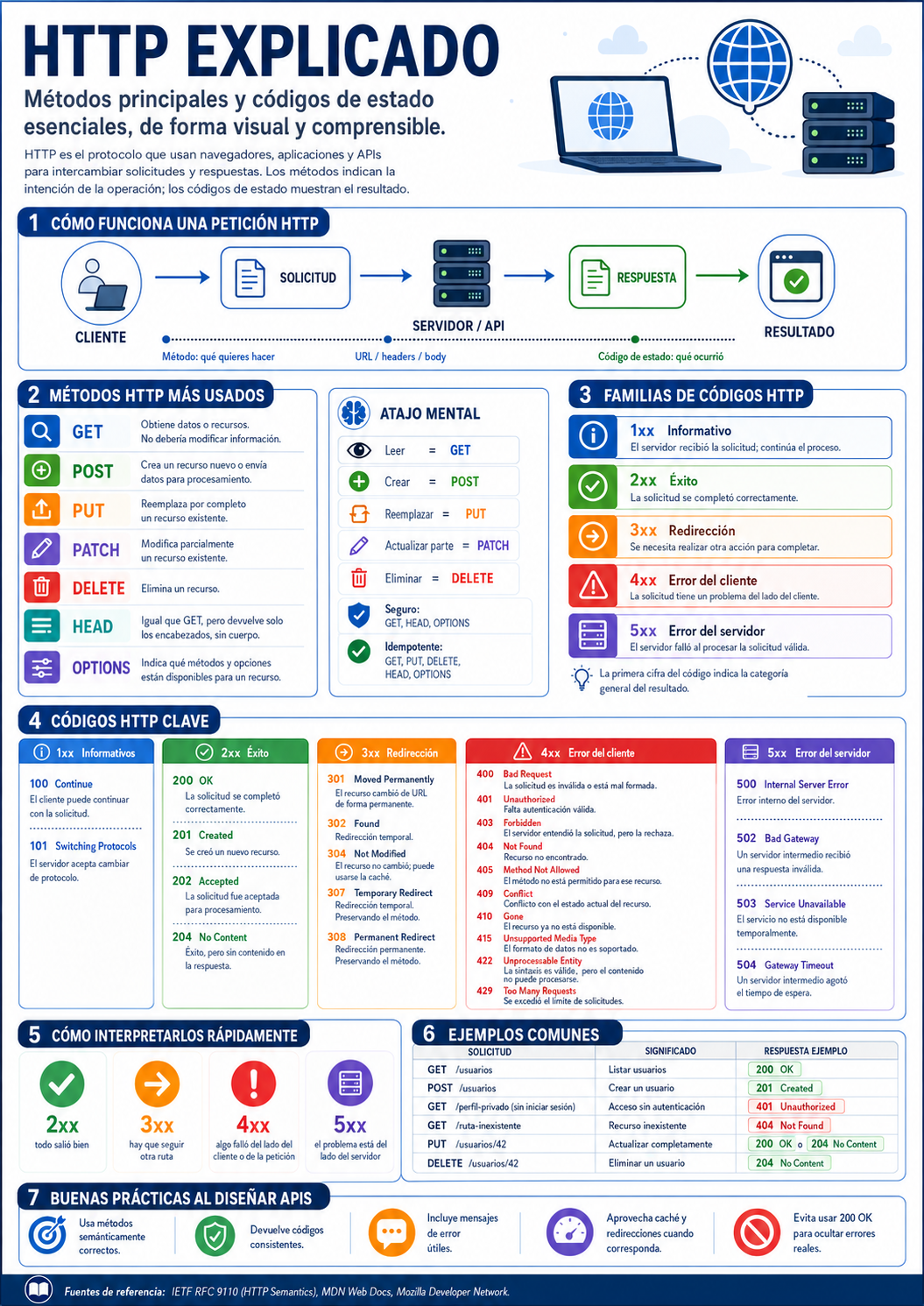
An infographic in Spanish that summarizes how an HTTP request works, the most commonly used methods, status code families and examples, a quick guide to interpreting status codes, and best practices for designing APIs.
- Complexity
- Introductory
- Reading
- 5 min read
- Published
While the image is fitted, the left and right arrows move to the previous and next infographic. Once it is zoomed in, the arrows move the image instead. The plus and minus keys zoom, and the zero key fits it again.
Loading the image…
About this infographic
Editorial summary of visible content: • HTTP flow: Client → Request → Server/API → Response → Result. The request includes the method, URL, headers, and body; the response indicates what happened using a status code. • Most commonly used methods: GET (get), POST (create), PUT (replace), PATCH (partially update), DELETE (delete), HEAD (headers), OPTIONS (options). • Mnemonic: Read = GET; Create = POST; Replace = PUT; Partial Update = PATCH; Delete = DELETE. Safe methods: GET, HEAD, OPTIONS. Idempotent methods: GET, PUT, DELETE, HEAD, OPTIONS. • Status code families: 1xx Informational; 2xx Success; 3xx Redirection; 4xx Client Error; 5xx Server Error. • Key status codes shown: 100 Continue, 101 Switching Protocols; 200 OK, 201 Created, 202 Accepted, 204 No Content; 301 Moved Permanently, 302 Found, 303 See Other, 304 Not Modified, 307 Temporary Redirect, 308 Permanent Redirect; 400 Bad Request, 401 Unauthorized, 403 Forbidden, 404 Not Found, 405 Method Not Allowed, 409 Conflict, 410 Gone, 415 Unsupported Media Type, 418 I’m a teapot, 422 Unprocessable Entity, 429 Too Many Requests; 500 Internal Server Error, 502 Bad Gateway, 503 Service Unavailable, 504 Gateway Timeout. • Quick interpretation: 2xx everything is fine; 3xx take another route/redirect; 4xx client problem; 5xx server problem. • Examples of requests and responses (as shown): GET /users → 200 OK; POST /users → 201 Created; POST to a private resource without a session → 401 Unauthorized; GET to a nonexistent route → 404 Not Found; PUT /users/42 → 204 No Content; DELETE /users/42 → 204 No Content. • Best practices: use semantic methods; return consistent status codes; include helpful messages; take advantage of caching and redirects when applicable; avoid using 200 OK to hide errors.
Key takeaways
- HTTP uses methods to express intent (GET, POST, PUT, PATCH, DELETE, HEAD, OPTIONS).
- The basic cycle: the client sends a request; the server responds with a code that summarizes the result.
- Code families: 1xx informational, 2xx success, 3xx redirection, 4xx client error, 5xx server error.
- GET, HEAD, and OPTIONS are considered safe; GET, PUT, DELETE, HEAD, and OPTIONS are idempotent.
- Status codes: 200, 201, 204; 301–308 for redirects; 400, 401, 403, 404, 405, 409, 415, 422, 429; 500–504.
- Quick guide: 2xx means everything is okay; 3xx indicates alternative routes; 4xx is the client's fault; 5xx is the server's fault.
- Practical examples include listing, creating, updating, and deleting resources with common responses (200, 201, 204, 401, 404).
- Best practices: Use semantic methods, consistent codes, clear messages, caching/redirects, and don't hide errors with a 200 status code.