Modern Software Testing Methods: A Layered Guide and Practical Strategy
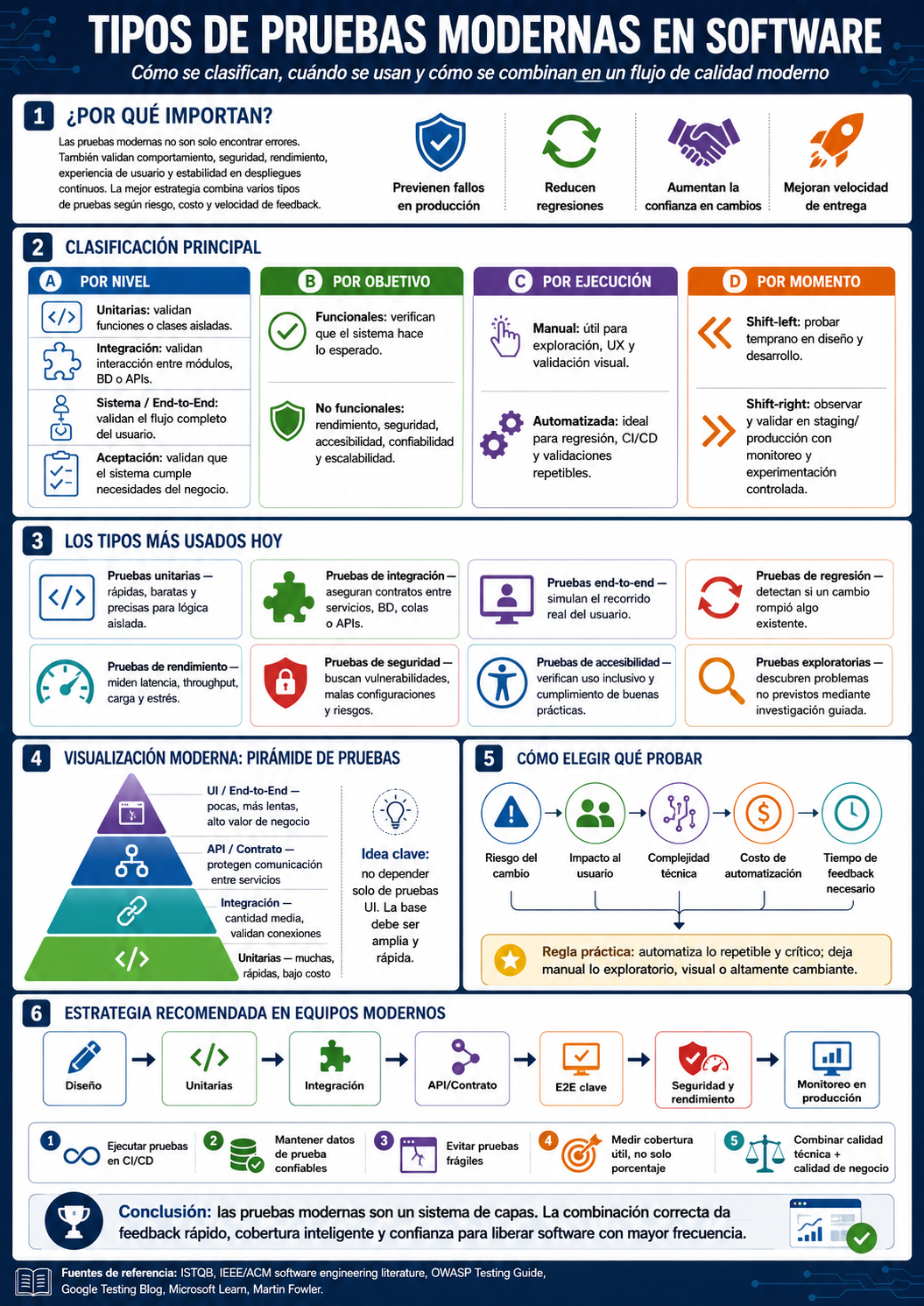
A visual overview of how modern software tests are classified and prioritized, when to use them, and how to combine them into a quality pipeline with CI/CD.
- Complexity
- Introductory
- Reading
- 5 min read
- Published
While the image is fitted, the left and right arrows move to the previous and next infographic. Once it is zoomed in, the arrows move the image instead. The plus and minus keys zoom, and the zero key fits it again.
Loading the image…
About this infographic
Editorial summary of visible content: - Why they matter: They help prevent production failures, reduce regressions, increase confidence when making changes, and accelerate delivery. - Main classification: • By level: unit (isolated logic), integration (between modules/databases/APIs), system/end-to-end (full user flow), and acceptance (business requirements). • By objective: functional vs. non-functional (performance, security, accessibility, reliability, scalability). • By execution: manual (exploration, UX, visual validation) and automated (regression, CI/CD, repeatable checks). • By timing: shift-left (early in design/development) and shift-right (validation/observation in staging/production with monitoring and controlled experimentation). - Most commonly used types: unit, integration, end-to-end, regression, performance, security, accessibility, and exploratory. - Testing pyramid (visualization): broad and fast base with unit tests; middle layer of integration tests; API/contracts to ensure communication integrity; few UI/end-to-end tests, as they are slower but high-value. - How to choose what to test: assess the risk of the change, user impact, technical complexity, automation cost, and feedback time. Rule of thumb: automate what is repeatable and critical; keep exploratory, visual, or highly changeable tests manual. - Recommended strategy: flow from design → unit tests → integration → API/Contract → key E2E → security and performance → production monitoring. Best practices: run tests in CI/CD, use reliable test data, avoid fragile tests, measure useful coverage rather than percentage, and combine technical quality with business quality.
Key takeaways
- Organize the tests by level, objective, execution method, and timing (shift-left/right).
- It prioritizes a broad base of unit tests and integration; it uses few UI/E2E tests due to their cost and slowness.
- Automate repeatable and critical tasks (regression testing, CI/CD); leave exploratory or rapidly changing tasks to be done manually.
- Select what to test based on risk, impact, complexity, cost, and speed of feedback.
- It includes performance, security, and accessibility tests, in addition to functional tests.
- Modern strategy: layered pipeline with CI/CD, reliable data, avoiding fragile tests, measuring useful coverage, and aligning technical quality with business quality.
- The right approach builds confidence in changes and speeds up delivery.